
Collagen vs Collagen Peptides: What the Label Really Means and What Research Shows
Collagen vs collagen peptides: what hydrolysis changes, why labels often mean the same ingredient, what skin studies show, and how to compare two powders.

In a nutshellCollagen is a large structural protein, and collagen peptides are that same protein broken into smaller pieces through hydrolysis. On supplement labels, “collagen peptides,” “hydrolyzed collagen” and “collagen hydrolysate” usually describe the same ingredient, so the ingredient list matters more than the name on the front. Human studies on skin are encouraging but mixed, and results depend on the exact formula tested.
If you have stood in a health food store comparing two tubs of powder, one labelled collagen and one labelled collagen peptides, you are not alone in wondering whether you are looking at two different products or two different marketing departments. The honest answer is: often the latter. But there are real differences worth knowing about, and they sit in processing, sourcing and evidence rather than in the headline wording.
This guide is written for busy people who want a clear answer without a chemistry degree. We will look at what collagen is, what happens when it becomes collagen peptides, what the research actually says about absorption and skin, how collagen fits into an ordinary diet, and how to compare two products in under a minute at the shelf.
What Is Collagen?
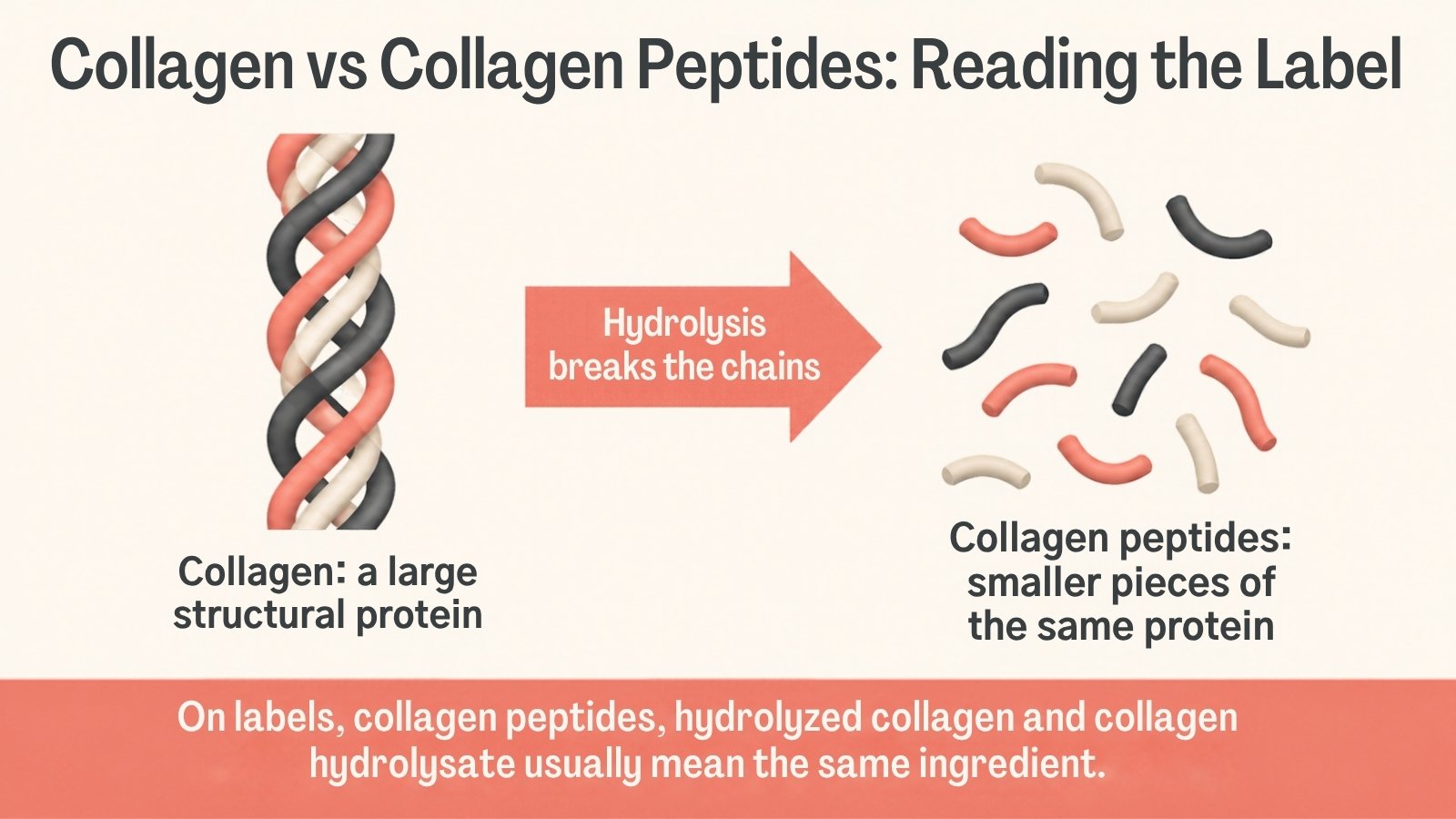
Collagen is a protein that helps give structure to your connective tissues. Skin, tendons, ligaments, cartilage and bone all rely on it. Its long chains twist together into a distinctive rope-like triple helix, which is part of what makes collagen strong and slightly stretchy at the same time.
Your body makes its own collagen from amino acids, and it needs vitamin C to do so properly. That link is why severe vitamin C deficiency, the condition historically known as scurvy, shows up in tissues like gums and skin that depend heavily on healthy collagen. In other words, collagen is not something your body can only get from a scoop; it is something your body builds every day from the protein and nutrients in your overall diet.
Collagen in food comes mainly from animal connective tissue: skin, bones and cartilage of cattle, pigs, poultry and fish. Slow-cooked cuts, bone broth and gelatin-based foods all contain it in some form.
What Are Collagen Peptides?
Collagen peptides are what you get when manufacturers break collagen’s long chains into much smaller fragments. The process is called hydrolysis, usually done with enzymes, and it produces a mixture of short peptides. A detailed review in the journal Molecules on hydrolyzed collagen sources and applications describes how this processing works and why the result dissolves easily in water and blends into drinks without gelling.
That dissolving property is a big part of the appeal. Gelatin, which is collagen that has been partly broken down by cooking, sets into a jelly when it cools. Fully hydrolyzed collagen peptides do not, which is why they can be stirred into coffee or a smoothie.
The naming problem
Here is the twist that trips up most shoppers. The Peptides Blog points out in its explainer on the real difference between collagen and collagen peptides that on supplement labels, “collagen peptides,” “hydrolyzed collagen” and “collagen hydrolysate” generally describe the same kind of ingredient. A tub that simply says “collagen” on the front may contain hydrolyzed peptides too. So a comparison of “collagen vs collagen peptides” in the supplement aisle may be a comparison of the same thing in two outfits.
The words that do carry useful information are different ones. “Marine,” “bovine” or “porcine” tells you the animal source. “Type I,” “type II” or “type III” tells you which family of collagen the product claims to emphasize. Serving size tells you how much you actually get. None of those, on its own, tells you whether a product delivers a particular benefit.
Collagen Types on the Label: I, II and III
Collagen is not a single uniform protein. Scientists have identified many types, and supplement labels often name one or more of them. The three you will see most often are these.
Type I is the most abundant type in the human body. It is a major component of skin, bone, tendons and ligaments, and it is the type most often emphasized in powders marketed for skin.
Type II is the main collagen in cartilage, the cushioning tissue in joints. Products aimed at joints sometimes emphasize it, often sourced from chicken cartilage.
Type III often appears alongside type I in skin and in the walls of blood vessels and some internal organs.
Two cautions apply. First, once collagen is hydrolyzed and digested, your body receives peptides and amino acids rather than an intact type I or type II structure, so the type on the label is more a description of the source than a guarantee of where the material ends up. Second, some joint products use a non-hydrolyzed form of type II collagen that is studied on a different theory from hydrolyzed peptides. That makes it a genuinely different product category, and evidence for one does not carry over to the other.
Why Collagen Changes With Age
Much of the interest in collagen comes from the visible changes skin goes through over time. Collagen production in skin slows gradually as we get older, and existing collagen fibres become more fragmented. Sun exposure speeds this up considerably: ultraviolet light damages collagen in the skin, which is why sun-exposed areas such as the face and back of the hands tend to show wrinkles and loss of firmness earlier than covered areas. Smoking also harms skin collagen.
This is why dermatologists consistently put daily sun protection and not smoking at the top of the list for preserving skin collagen. Those steps protect the collagen you already have, which is a more reliable strategy than trying to replace it from the outside. Supplements, if you choose to use them, sit on top of that foundation rather than substituting for it.
Collagen vs Collagen Peptides: Side by Side
| Feature | Intact collagen (in food or gelatin) | Collagen peptides (hydrolyzed) |
|---|---|---|
| Structure | Long chains, triple helix (gelatin is partly broken down) | Short fragments from enzymatic hydrolysis |
| In water | Gelatin gels when cooled | Dissolves without gelling |
| Typical sources | Bone broth, slow-cooked cuts, gelatin desserts | Powders, capsules, ready-to-drink products |
| Digestion | Broken down by the body into peptides and amino acids | Arrives already partly broken down |
| Label wording | “Gelatin,” “collagen” | “Collagen peptides,” “hydrolyzed collagen,” “collagen hydrolysate,” sometimes just “collagen” |
Are Collagen Peptides Easier to Absorb?
This is the most common claim on the front of the tub, and there is some real evidence behind the processing part of it. In a small randomized crossover study published in the journal Nutrients, researchers compared enzymatically hydrolyzed collagen with non-hydrolyzed collagen in ten healthy men, each of whom took each preparation, plus water, on separate days. Both collagen preparations raised blood amino acid levels. The enzymatically treated version produced faster absorption and greater availability of several amino acids that are abundant in collagen.
That is a meaningful result, but its limits are important. It was a small study. It measured blood levels over four hours, not skin, joints or anything you would notice in the mirror. And it tells us about the processing step in general, not about the absorption of every product on the market. Faster absorption is a reasonable starting point for further research, not proof of a visible benefit.
It is also worth remembering that your digestive system breaks all dietary protein into peptides and amino acids anyway. Eating collagen-rich food does not deliver intact collagen to your skin. Hydrolyzed products simply start that process earlier.
What Do Human Studies Say About Skin?
Skin is where most collagen marketing focuses, so it is where the evidence deserves the closest look.
There are encouraging findings. A 2018 randomized, placebo-controlled trial published in Nutrients assigned 64 participants to either a specific low-molecular-weight collagen peptide formulation or a placebo for 12 weeks. The collagen group showed improvements in skin hydration and several measures of wrinkles and elasticity. As The Peptides Blog notes, some of the authors worked for companies involved in collagen products, and that context belongs next to the results.
The wider picture is less settled. A 2025 analysis in The American Journal of Medicine pooled 23 randomized trials with 1,474 participants. Across all studies combined, it found improvements. But when the analysis was limited to high-quality studies, or to studies without pharmaceutical company funding, the benefits were no longer statistically significant. That pattern does not prove collagen does nothing. It does mean the size of any benefit for an ordinary consumer is uncertain, and that study quality and funding matter when reading headlines.
This dermatologist’s video gives a balanced, practical walkthrough of how collagen peptides are thought to work and what the trials can and cannot show:
One more lesson from the research: a positive trial of one specific formula does not validate every product that carries the words collagen peptides. Different products contain different peptide mixtures, doses and added ingredients. If a brand points to “clinical studies,” the useful question is whether those studies tested that brand’s own formula.
Collagen as Part of Everyday Nutrition
On healthtipsnew we always come back to the basics, and collagen is a good example of why. Collagen peptides are a protein source, and like any protein they contribute amino acids. But collagen is an incomplete protein: it contains very little of the essential amino acid tryptophan, so it should not be your main protein source. It works as an addition to a varied diet, not a replacement for meals built around complete proteins.
If you are trying to support your skin and connective tissue through food, the fundamentals do most of the work: enough total protein, plenty of vitamin C from fruit and vegetables, adequate sleep, sun protection and not smoking. Our guide to simple nutrition habits for busy adults covers how to build balanced meals without overthinking them, and our list of small daily habits that add up includes several that matter for skin as much as anything in a tub.
Food sources of collagen
Bone broth: made by simmering bones and connective tissue for a long time. The collagen content varies widely depending on recipe and cooking time.
Gelatin: a cooked form of collagen used in desserts, gummies and some recipes.
Slow-cooked tough cuts: cuts with lots of connective tissue, such as shanks, oxtail and chicken feet, soften precisely because collagen breaks down into gelatin during long cooking.
Fish skin: a common source for marine collagen products and part of many traditional cuisines.
How to Compare Two Collagen Products in Under a Minute
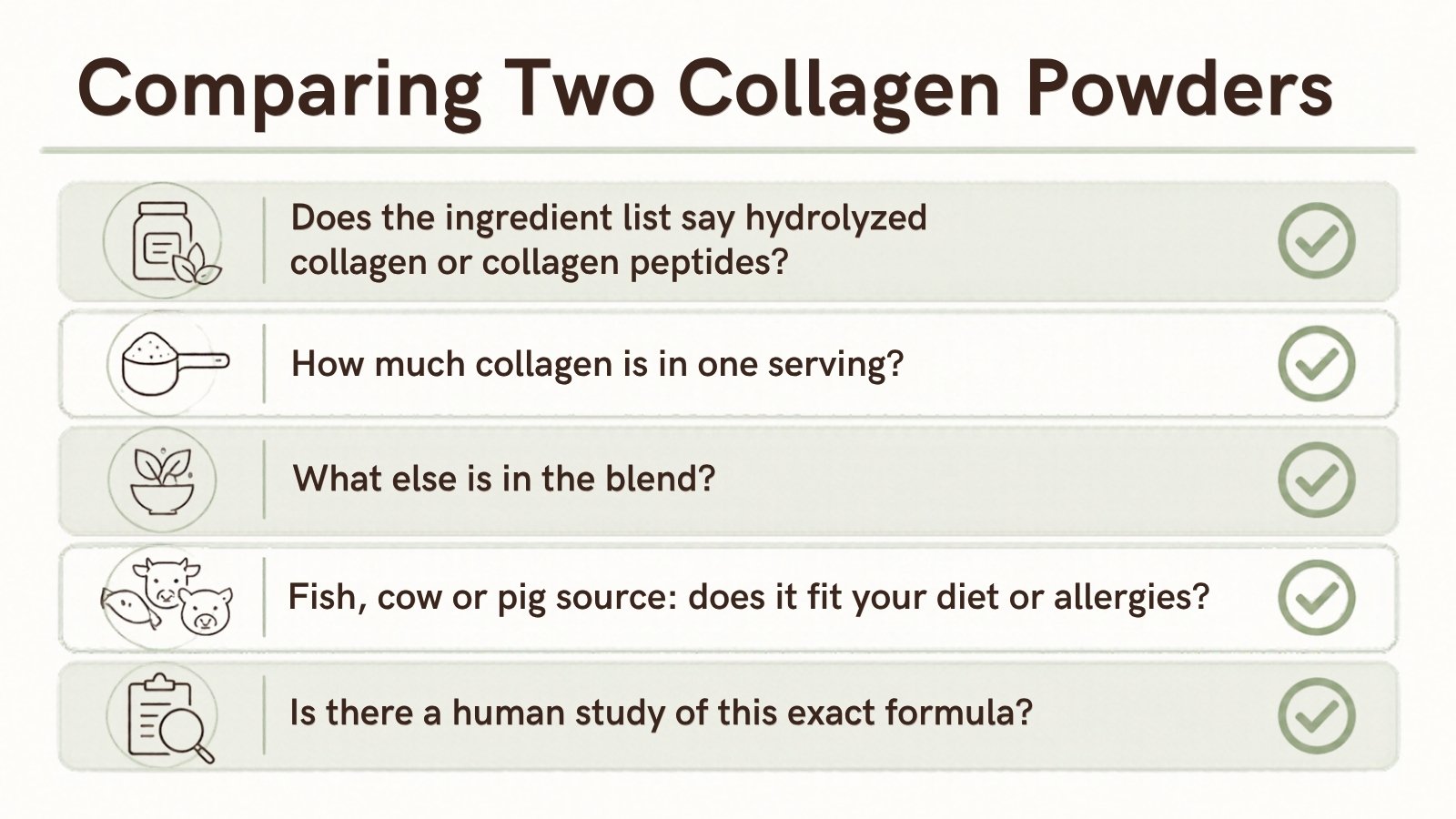
1. Read the ingredient list, not the headline. If both products list hydrolyzed collagen or collagen peptides, the front-label wording is not a real difference.
2. Compare collagen per serving. Scoop sizes vary. Look at the actual grams of collagen in one serving.
3. Check what else is in it. Blends with added vitamins, flavours, sweeteners or other active ingredients are different products. A trial of a blend cannot tell you what collagen alone contributed.
4. Note the source. Fish, bovine and porcine collagen may matter for allergies, religious practice or dietary preferences. There is little evidence that one source is automatically better absorbed than another.
5. Look for evidence on the exact formula. If the brand claims a benefit, find out whether a human study tested that formula, what was measured, for how long and who funded it. The Peptides Blog walks through these steps in its guide on judging whether a supplement study supports a claim.
Safety, Regulation and Who Should Take Extra Care
Collagen supplements are sold as dietary supplements in the United States. That category works differently from medicines. As FDA explains in its information for consumers on using dietary supplements, supplements do not need FDA approval for safety and effectiveness before they are sold, and the agency encourages people to talk with a healthcare professional about supplement use.
A few groups should take particular care. People with fish or shellfish allergies should check the source of marine collagen. People following vegetarian, vegan, halal or kosher diets should check the animal source and any certification. Anyone who is pregnant, breastfeeding, managing kidney disease or taking several medications should run new supplements past a clinician. And everyone should be cautious of products that combine collagen with long lists of other active ingredients, since each addition brings its own considerations.
Common Collagen Myths
“Collagen peptides are a completely different ingredient from collagen.” They are the same protein in smaller pieces, and labels often use the terms interchangeably.
“The collagen you eat goes straight to your skin.” Dietary collagen is digested into amino acids and small peptides like other proteins. The body then uses those building blocks where it needs them.
“Marine collagen is always absorbed better.” A 2024 human study comparing fish, pig and cattle hydrolysates found comparable uptake of hydroxyproline across the preparations tested, which gives little support to automatic claims of superior marine absorption.
“A clinical study proves this brand works.” Only if the study tested that brand’s exact formula, measured an outcome you care about and was well designed. Many brands cite studies on other products.
“More collagen is always better.” There is no evidence that very large doses produce better results, and collagen should not crowd out complete protein sources in your diet.
The Peptides Blog has a useful companion piece on how to evaluate peptide and collagen claims from influencers, which is handy if most of your collagen information comes from social media.
What About Vegan Collagen?
True collagen comes from animals, so there is no plant that produces it. Products marketed as vegan collagen are usually blends of amino acids, vitamin C and plant extracts intended to support the body’s own collagen production, rather than collagen itself. That can be a reasonable option for people who avoid animal products, but it is a different product from collagen peptides, and evidence for one does not automatically apply to the other. Read the ingredient list to see what you are really buying.
So, Collagen or Collagen Peptides?
For most shoppers, the choice is not really between collagen and collagen peptides, because many products labelled either way contain hydrolyzed collagen. The more useful choice is between specific products, based on what is in them, how much you get, where it comes from and whether there is decent evidence for the benefit you are after.
If you enjoy a collagen powder in your morning coffee and it fits your diet and budget, that is a reasonable personal choice. Just keep expectations grounded, treat it as an addition rather than a foundation, and give the basics of nutrition, sleep and sun protection the attention they deserve.
To keep learning with sources you can check, explore peptide benefits and the research behind them at The Peptides Blog’s plain-language research guides, an independent educational publication that does not sell supplements or peptides.
Practical Tips If You Decide to Use Collagen Peptides
If you have weighed the evidence and want to try a collagen product, a few practical habits help you get a fair read on whether it is worth continuing.
Pick one plain product. Start with a product that lists only collagen peptides, so you know what you are actually testing.
Keep everything else steady. If you change your skincare routine, diet and supplement at the same time, you will not know which change made a difference.
Give it a defined trial period. Studies on skin typically run for several weeks to a few months. Decide in advance how long you will try it and what you will look for.
Take photos in consistent light. Our memories of how our skin looked a month ago are unreliable. Photos taken in the same spot and lighting give you a fairer comparison.
Mix it into what you already drink. Hydrolyzed collagen dissolves in hot and cold liquids, so adding it to coffee, tea, soup or a smoothie is the easiest way to be consistent.
Watch the budget. Collagen products range widely in price. A higher price does not mean a better formula, and the most useful comparison is cost per gram of collagen.
Frequently Asked Questions
Is there a difference between collagen and collagen peptides?
Collagen is the full protein; collagen peptides are that protein broken into smaller pieces by hydrolysis. On supplement labels, though, the terms often describe the same hydrolyzed ingredient, so check the ingredient list.
Is hydrolyzed collagen the same as collagen peptides?
Generally yes. “Hydrolyzed collagen,” “collagen hydrolysate” and “collagen peptides” usually describe the same type of processed ingredient.
Are collagen peptides absorbed better than regular collagen?
A small human study found that enzymatically hydrolyzed collagen was absorbed faster than a non-hydrolyzed preparation, measured by blood amino acids over four hours. That does not by itself show a larger benefit for skin or joints.
Do collagen supplements improve skin?
Some individual trials report improvements in hydration and elasticity, but a 2025 analysis found the benefits were not significant when limited to high-quality or independently funded studies. The evidence is promising but not settled.
Can I get collagen from food instead of supplements?
Yes. Bone broth, gelatin, slow-cooked cuts with connective tissue and fish skin all contain collagen. Your body also makes its own collagen from dietary protein and needs vitamin C to do so.
Is collagen a complete protein?
No. Collagen contains very little tryptophan, an essential amino acid, so it should complement rather than replace complete protein sources.
Health information disclaimer
This article is for general educational purposes and does not provide medical or nutritional advice tailored to you. It does not recommend or endorse any supplement or brand, and dietary supplements are not intended to diagnose, treat, cure or prevent any disease.
Supplements are not approved by FDA for safety and effectiveness before sale, and regulations differ between countries. Check for allergies and dietary restrictions, and speak with a doctor, pharmacist or registered dietitian before starting a supplement, especially if you are pregnant, breastfeeding, managing a health condition or taking medication.

Dana Burns
More articles by this author